I apologize for how long it took me to finally post something this week, it's been pretty busy and I just haven't seemed to have the time. Without further ado, the post that should have been on Monday!
So when I first saw the name Holofernes in Love's Labour's Lost, the first image I got was the picture to the left: Judith Beheading Holofernes by Gentileschi. This play has so much girl power in it, it wouldn't be terribly surprising if Shakespeare was making an allusion to the book of Judith.
 |
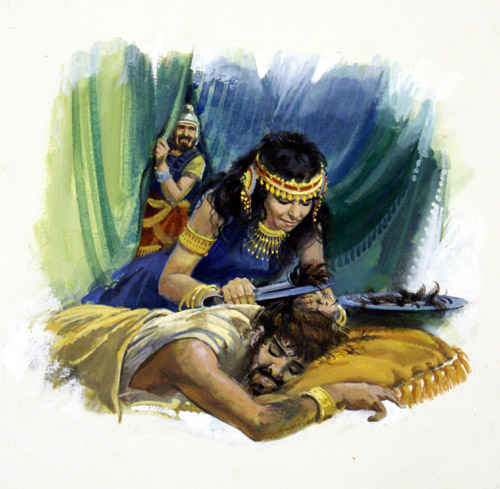
| You can imagine the meeting between Judith and Holofernes looking something like this. |
For those of you unfamiliar with the Biblical Apocrypha, Holofernes, one of Nebuchadnezzar's more stupid generals, was warned not to attack the Hebrew people, but, like all archetypal idiots, he simply told the poor guy to buzz off. Holofernes laid siege to the Hebrew city and cut off the water supply, which sucked for all the dehydrated people trapped within the gates, who nearly surrendered before a bravely promiscuous woman named Judith stepped forward and volunteered her feminine assets to save the city. So when Judith and Holofernes were alone in his tent, he fell asleep, and Judith, seeing her opportunity, totally chopped his head off with his own sword! Afterwards, she stuffed his head into a sack and waltzed right out of the camp with it. In the morning, the Hebrews marched out of their city, bearing Holofernes' head like a banner, so completely demoralizing Holofernes' army that they are easily defeated.

However, this picture is much more similar to the Holofernes that Shakespeare was referencing. Many scholars believe that Shakespeare was taking Rabelais' character Holofernes, the absurd parody of medieval scholars, and how ineffective they were at teaching. Rabelais' character is a "Sophist in Latin Letters" and focuses primarily on memorization instead of analysis. Reblais illustrates just how impotent he is as a teacher to the the main character of the narrative, completely unable to teach his young pupil anything. Fairly quickly, the main character's father finds a new, much more intelligent scholar to tutor his son, simply because Holofernes has no true merit in his studies. It isn't difficult to see the connection with Shakespeare's Holofernes, the equally impotent scholar, quoting his Latin phrases. More details on Reblais' work here.
However, this doesn't mean we can't draw parallels with Judith's arch-enemy. Holofernes, with his criticisms and tiring pedantry can be seen almost attacking wit and language, imposing his harsh rules on them and scoffing at anyone who isn't so scholarly as to make you fall asleep. However, the ever clever women of the play are putting the wit back in witticisms, launching a counterattack against the pompous air the men put on. Unfortunately, there is no gory beheading at the end.