Showing posts with label Caliban. Show all posts

Thursday, October 27, 2011

Oops

Hey guys, so I actually meant to post this on time on Monday, but I guess I didn't actually publish it. I found it today among my drafts after I realized that it hadn't been posted. So without further ado, Mondays post.


So reading through The Tempest, I decided to take our professor's advice and take special note of who is in power and whether or not Prospero has control of the situation. Power is a fairly consistent theme throughout the play thus far, manifesting itself in just about every character.

One particular scene illustrating the balance of power is act II scene I after the party falls asleep, leaving Antonio and Sebastian to converse by themselves. The two agree to kill Alonso and Gonzago, the first so that they may both increase their political power, the second because they dislike him and believe that they have the power to get away with it. However, despite how confident they are in their power, Prospero, through Ariel, is the one really controlling the situation. Ariel causes Gonzalo to awaken, therefore foiling the plot of the two power-hungry jerk-wads.

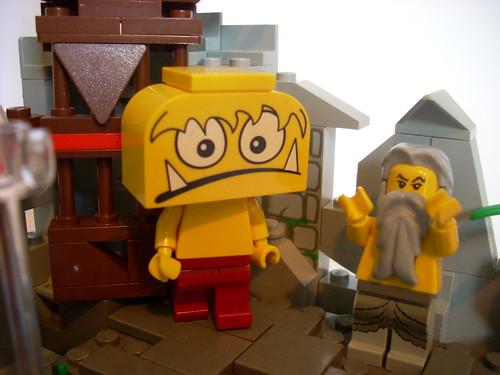
Ariel herself is an enigma and contradiction of power. Without Ariel, Prospero would essentially be powerless, since everything he does is through his command of Ariel. Ironically, Ariel is arguably the most naturally powerful person in the play, yet is tethered down to Prospero's whim and decree, completely powerless for all of Ariel's magic. And yet, despite Ariel being the source of Prospero's power, he bullies her into submission to do his will. At the first sign of resistance from Ariel, Prospero reminds him/her of the debt owed to Prospero, claiming that he/she is ungrateful and has forgotten the pain and torment of Sycorax's spells. Power corrupts. Absolute power corrupts absolutely. And Prospero is certainly going through a power trip. Which brings us to Prospero's other slave, Caliban.


Despite his strength and physical superiority to Prospero, the misshapen native grudgingly serves Prospero simply because to do so is less painful than outright defiance. Prospero uses his magic to torment Caliban when he doesn't yield to Prospero's commands. Starting to see the corruption yet?

Another major scene that contributes to the overall theme of power is act III scene II where Caliban defects to serve a drunkard that offers him wine. It is fairly obvious that Stephano, the man that Caliban has chosen to serve, is below Prospero in station and power, yet Caliban chooses him over Prospero because he offers reward instead of punishment. This furthers out understanding of the relationship between Prospero and Calban. From my point of view, Caliban gains absolutely nothing from serving Prospero besides relief from punishment.

Tuesday, October 18, 2011

Caliban, the corrupted cannibal

So yeah, sorry I'm late again guys, things have been busy lately but I'm going to try really hard to be on time on Friday.

I don't know about you, but I'm WAY excited for The Tempest. It's so ridiculously archetypal, much like The Winter's Tale, that it's difficult not to connect it to other things. For example,
Caliban
is like
Gollum
and
Grendel
because each character illustrates the corruption of dark magic upon the natural world. Grendel, much like Caliban, was born of a dark witch, deformed and twisted by the magic within her, more like a tumor than a man. Gollum was born whole, but, through exposure to dark magic and evil after a period of years, he too became deformed and grotesque--much like getting cancer after being exposed to too much nuclear waste. Then there's Caliban, the spawn of a hag and Satan himself, born with inhuman form and evil so deep within him that, despite the efforts of Prospero the civilizer, he can only take what he is given and twist it into something crude, like when he was taught to speak only that he would curse Prospero for keeping Caliban away from Miranda.


That said, we can compare Prospero with Beowulf, the tamer and purger of corruption, the civilizer. Much like Beowulf, Prospero comes to a place beseiged with corruption and danger and immediately makes it safe for the inhabitants, namely his little girl, Miranda. He seeks to purify the corruption, to teach it manners and rhetoric, and subdues it to create a safe place. Good thing for Prospero that Caliban's mother is already dead, otherwise he might find himself creating new corruption.